
THE MOST POWERFUL FRONT ROW IN MILAN WASN’T BUILT IN MILAN.
What Becky Armstrong, Tod’s and the rise of Thai fandom reveal about the new infrastructure of fashion influence.
“Before casting the face, map what moves behind it.”
22–28 September 2026. This is the week in which BRABA is publishing the analysis.
The case belongs to the February–March 2026 edition. CNMI lists the previous women’s edition as 24 February–2 March 2026.
Onclusive’s data collection starts one day before the official event window and runs through 2 March 2026.
The audience that changes the scale may never enter the building.
Milan Fashion Week is built around physical scarcity.
A limited number of people enter the venue. Fewer sit in the front row. Every position inside the room communicates status, access and proximity to the brand.
But the audience capable of changing the scale of the event may never enter the building.
This Field Note is being published during Milano Fashion Week SS27. The evidence below does not belong to the current shows. It comes from the previous Fall/Winter edition in February and March 2026, using Onclusive’s social-listening analysis as the primary dataset.
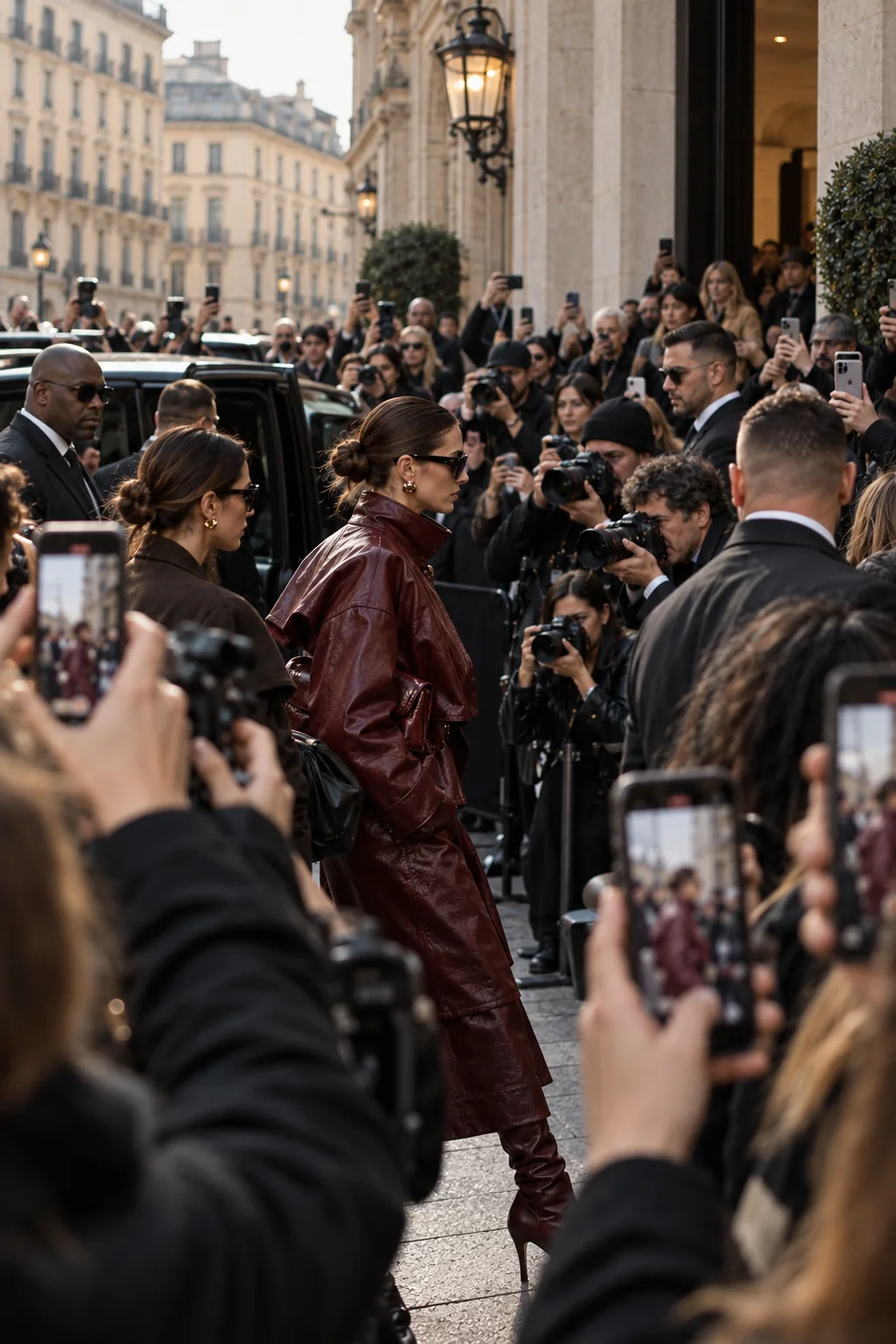
During that FW26 monitoring window, Thai entertainment stars and their fan communities produced one of the clearest signals of how fashion influence is changing. The visible part of the system was familiar: actors, singers and ambassadors attending shows for major European brands.
The less visible part was more consequential.
Behind those appearances sat organised communities capable of producing hashtags, editing clips, translating information, coordinating publication times and extending a few minutes of physical presence into days of social circulation.
The talent occupied the seat. The community expanded the event.
The numbers behind the seat.
Onclusive monitored Milan Fashion Week between 23 February and 2 March 2026. Its analysis covered 153 fashion brands and 173 ambassadors and celebrities across social and mainstream media, with social listening spanning X, Instagram, TikTok, Facebook, Threads and additional platforms in the company’s data window.
The company reported 4.97 million social mentions from 2.91 million unique accounts and a potential social reach of 127 million. Potential reach is not delivered attention, but the scale of participation is still material.
Onclusive’s monitored MFW FW26 conversation volume.
Accounts that generated at least one mention in the monitoring window.
A potential exposure estimate, not confirmed delivered attention.
With 173 ambassadors and celebrities tracked.
Tod’s finished the monitoring period with 19.11 per cent of brand share of voice. Gucci followed with 18.82 per cent. The difference between them was less than one percentage point.
Onclusive attributed a substantial part of Tod’s edge to Thai fan activity around Becky Armstrong and Pooh Krittin. Becky represented 11.4 per cent of celebrity share of voice and Pooh 7.3 per cent. The hashtag #BeckyxTodsFW26 produced 558,892 mentions, while #TodsFW26 reached 745,887.
Becky was not the largest individual signal. Keng Harit led the celebrity ranking with 20.4 per cent of share of voice. Namping Napatsakorn followed with 13.7 per cent. Becky came third. Onclusive’s top ten were all from Asia, and its top three were Thai.
That changes the question.
The interesting question is no longer simply who was important enough to sit in the front row.
It is what became possible because they were there.
The front row has a second function.
Fashion has always used its guest list to display proximity.
Editors established institutional legitimacy. Buyers represented commercial access. Celebrities created aspiration. Clients signalled wealth and loyalty. The seating plan turned social hierarchy into physical architecture.
That function has not disappeared.
But another one has been placed on top of it.
The front row is becoming a trigger for distributed participation.
When Becky Armstrong appeared at Tod’s, the brand did not only receive an image of a famous person wearing its clothes. The appearance gave an existing community a reason to organise around the brand.
Fan accounts prepared tags. Multiple spellings and scripts helped the conversation travel between languages. Images were selected, edited and reposted. Short clips turned arrival, clothing, gesture and interaction into separate content moments. Activity continued after the show itself had ended.
The distribution was not produced by one account.
It emerged from a network.
Followers are visible. Community capability isn’t.
Two talents can present similar audience numbers and produce very different consequences.
One audience watches.
Another translates, archives, edits, coordinates and returns.
This distinction is frequently lost because creator and talent selection still begins with visible profile data: follower count, engagement rate, demographics, image, previous partnerships and estimated media value.
Those indicators are useful. They are also incomplete.
They describe the person at the centre of the network more easily than they describe the behaviour around that person.
A community has capabilities. It may know how to mobilise quickly, maintain shared accounts, create recurring rituals, translate into multiple languages, organise collective actions or keep a cultural moment alive after the platform has moved on.
None of this is guaranteed by audience size.
A large following can remain passive. A smaller but organised fandom can become a distribution system.
This is not only a creator story.
Becky Armstrong is an actor and singer, not a creator in the narrow professional definition of the word.
That distinction matters. Calling every visible person a creator makes the category useless.
But separating celebrities, creators, ambassadors and fan communities into unrelated marketing boxes creates another problem. Audiences do not experience those categories as clean departmental lines.
A performer can produce content. A creator can become a brand ambassador. A celebrity can operate a direct media channel. Fan accounts can become editors, translators and distributors. Community behaviour can influence how platforms interpret the relevance of every participant.
The strategic unit is therefore larger than the individual profile.
Brands need to examine the combination of the talent’s cultural role, the relationship with the audience, the community’s participation habits, the distribution behaviours around that community and the relevance of those behaviours to the brand’s actual objective.
A famous face is an asset. A role connected to a capable community is a system.
What Tod’s activated.
We do not know the full commercial terms, internal objectives or sales effects of Tod’s relationship with Becky Armstrong and Pooh Krittin. The public evidence does not support claims about conversion, revenue or long-term brand preference.
It supports a narrower conclusion.
Their presence corresponded with sustained, high-volume brand conversation across the monitored week.
That circulation appears to have been produced through several layers working together:
Recognition. The community already knew who the talent was and why the appearance mattered.
Ritual. The fashion show gave fans a specific time, object and brand around which to organise.
Translation. Names, references, images and reactions moved across languages and markets.
Distributed production. Different accounts produced edits, clips, photographs, commentary and reposts rather than waiting for one official brand asset.
Continuity. The community kept the appearance in circulation beyond the initial arrival photograph.
Tod’s did not have to manufacture that behaviour from zero. It entered a relationship in which the behaviour already existed.
That is the strategic difference between renting visibility and activating fandom.
Role before profile.
The usual casting question is: Who can give the brand the most reach?
A more useful sequence begins elsewhere.
What must happen after this person appears?
Should the talent explain the collection? Introduce the brand to another market? Give an existing community a reason to participate? Create cultural credibility? Produce editorial interpretation? Drive product discovery? Sustain attention after the event?
Only after defining the required role should the brand assess who can perform it.
The relevant evaluation is not limited to the person.
It includes the network around them.
A creator or ambassador brief should answer four questions before a name appears:
- What behaviour are we asking the audience to perform?
- What role must the talent play in making that behaviour possible?
- What community capability already exists around that person?
- What evidence would show that the behaviour continued beyond exposure?
This is role-before-creator applied to the front row.
Volume is not fandom.
There is an obvious risk in over-reading the numbers.
Share of voice measures conversation dominance. It does not prove affection, belonging, purchase or commercial return. Hashtag volume can show coordinated participation without demonstrating that the brand itself was understood. Potential reach is not delivered reach. Social circulation is not sales.
A fan community can also mobilise primarily for the person, leaving the brand as background scenery.
That counter-reading matters.
The next level of evidence would need to examine branded search in intended markets, qualified growth in the brand’s social audience, product discovery, traffic to owned surfaces, sustained association between talent and brand, repeat participation and measurable commercial behaviour.
Without those layers, the responsible conclusion remains limited to attention and circulation.
But that limited conclusion is already useful.
It shows that the same front-row seat can activate radically different levels of social behaviour depending on the community attached to it.
The real casting decision.
Fashion Week will continue to produce photographs of famous people sitting beside other famous people. The industry is very good at that.
The harder work happens before the photograph.
Brands need to understand what kind of relationship exists behind the talent, which behaviours that relationship can produce and whether those behaviours serve a real strategic objective.
The most valuable person in the room may not be the person with the largest following.
It may be the person whose community knows what to do next.
Before casting the face, map what moves behind it.
READ THE RECEIPTS.
Primary analysis: Onclusive, “Milan Fashion Week FW26 Women: Thailand Takes the Front Row”, published 3 March 2026 and updated 4 March 2026. Onclusive’s monitoring window runs from 23 February to 2 March 2026. Camera Nazionale della Moda Italiana lists the corresponding Fall/Winter 2026/2027 women’s edition as 24 February–2 March 2026, while the current Spring/Summer 2027 edition runs 22–28 September 2026.
- Onclusive — Milan Fashion Week FW26 analysis ↗
- Camera Nazionale della Moda Italiana — official edition dates ↗
- Camera Nazionale della Moda Italiana — current SS27 calendar ↗
Evidence boundary: the cited data demonstrates exposure, social circulation and share of voice. It should not be interpreted as proof of sales, brand preference, long-term fandom or commercial conversion.